


EXPLORE
YOUR FIELD OF INTEREST

Chemical Engineering
WM
One Chemical Engineering foundation. Three pathways to shape your expertise.
Chemical Engineering connects science, technology, and engineering to solve challenges across energy, environment, biotechnology, materials, and industrial processes. At WM-ChemE, students can explore their interests through three complementary fields.

Learn how chemical engineering can contribute to cleaner processes, resource efficiency, environmental protection, renewable resources, and circular systems.
Apply chemical engineering principles to biological systems, bioprocesses, biomaterials, and the transformation of renewable biological resources into valuable products.
Study the relationship between materials, process conditions, and engineering performance to develop advanced materials and more effective industrial processes.
The three fields are not separate degree programs. They provide different perspectives for exploring and applying the same strong Chemical Engineering foundation.
What Will You Explore?
Discover areas shaped by our recent research, laboratory activities, and emerging developments in chemical engineering.
🌱Green Sustainable Technology
GST
Engineering cleaner processes and transforming waste into valuable resources.
Waste & Biomass Valorization
Transforming agricultural, food, plastic, and industrial wastes into useful materials and products.
Water & Wastewater Treatment
Adsorption, advanced oxidation, membrane processes, and resource recovery for cleaner water.
Sustainable Energy & Fuels
Hydrogen production, water splitting, biofuels, and renewable-energy-related technologies.
Resource Recovery & Circular Economy
Recovery of valuable metals and materials from industrial residues, batteries, and other waste streams.
Green Process Development
Developing environmentally responsible synthesis, extraction, conversion, and treatment processes.
Sustainable Materials & Environmental Applications
Biomass-derived carbons, cellulose-based materials, and functional materials for environmental remediation.
🧬 Biotechnology & Bioengineering
BB
Engineering biological resources and bio-based systems into valuable products and technologies.
Bioprocess & Fermentation Engineering
Microbial processing, fermentation systems, immobilized cells, and bioprocess development.
Bio-Based & Functional Materials
Cellulose, pectin, chitosan, alginate, bacterial cellulose, and other renewable biopolymers.
Biomaterials & Controlled Delivery
Hydrogels, porous materials, and bio-based composites for controlled adsorption and release applications.
Food Biotechnology & Bioactive Compounds
Fermentation, functional compounds, food preservation, and bioactive-product development.
Biomass Conversion & Biorefinery
Transforming renewable biological resources and agricultural residues into higher-value products.
Biological & Enzymatic Technologies
Microbial synthesis, enzymatic modification, biodegradation, and biological approaches to sustainable processing.
⚙️ Material & Process Engineering
MPE
Designing functional materials and engineering processes for better performance.
Advanced Functional Materials
Metal–organic frameworks, nanomaterials, porous materials, composites, and engineered surfaces.
Adsorption & Separation Technologies
Development of high-performance adsorbents, membranes, and separation materials for targeted applications.
Material Synthesis & Characterization
Engineering material structure, surface chemistry, morphology, and properties for specific functions.
Catalysis & Photocatalysis
Catalytic and photocatalytic materials for chemical conversion, pollutant degradation, and energy applications.
Process Intensification & Optimization
Improving chemical processes through intensified synthesis, extraction, reaction, and separation strategies.
Process Modeling & Computational Engineering
Thermodynamic modeling, adsorption modeling, process analysis, simulation, and optimization of engineering systems.
Research without boundaries.
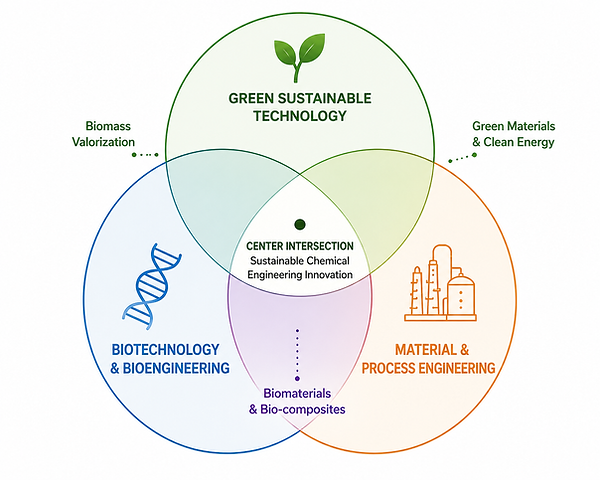
Many of our research topics connect more than one field—combining sustainability, biological resources, advanced materials, and process engineering to address real-world challenges.
Where the Fields Meet
Why Choose a Field of Interest?
Because interdisciplinary does not mean directionless.
Chemical engineering challenges rarely belong to a single field. Sustainable technologies may require advanced materials, while biotechnology may depend on process engineering and sustainability principles. Your Field of Interest gives you a primary direction for deeper exploration, while still allowing you to connect knowledge and approaches from other fields.
Think of it as your starting point, not your boundary.
FOCUS • EXPLORE • CONNECT
FOCUS
Choose an area that best matches your interests.
EXPLORE
Develop deeper knowledge through relevant electives, projects, and research.
CONNECT
Combine perspectives from other fields to solve complex engineering problems.

You develop depth through a field of interest and breadth through interdisciplinary exploration.
Build Depth. Connect Knowledge. Create Impact.